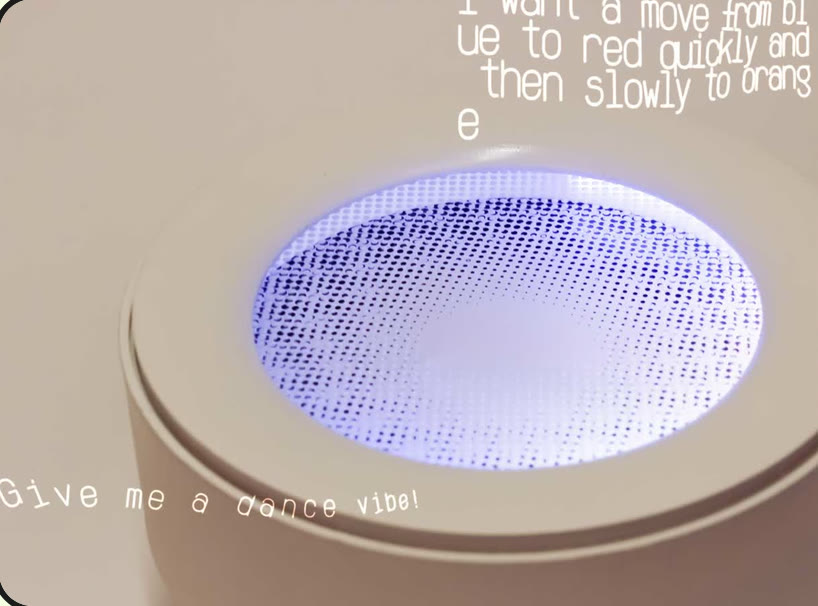
A round lamp-like artifact with its top disc glowing; handwritten prompts around it read 'Give me a dance vibe!' and 'I want a move from blue to red quickly and then slowly to orange'
PR-Circlelamp · online
Ask for a dance vibe — the lamp answers in light

Prototype things you can talk to

Prompting Realities is a low-threshold framework for building LLM-powered tangible interactions.

Describe your object to a language model in plain words. Talk to it. The model answers you in natural language and, in the same breath, emits structured JSON that drives your motors, lights and servos. No training, no fine-tuning, no custom parser — you write a description and a schema, and the thing starts behaving.

How it works

1

Describe the thing

You write a plain-language description of your artifact — what it is, what it can do, what its variables mean physically. That description is the whole “programming” step. The model learns the correspondence between a number in a JSON field and what it does in the room.

2

Talk to it

You talk to the artifact through a chat interface — a Telegram bot, the Control Hub, a voice loop. The conversation thread doubles as memory: rules, personalities and configurations you set earlier stay in play without being re-sent.

3

It acts

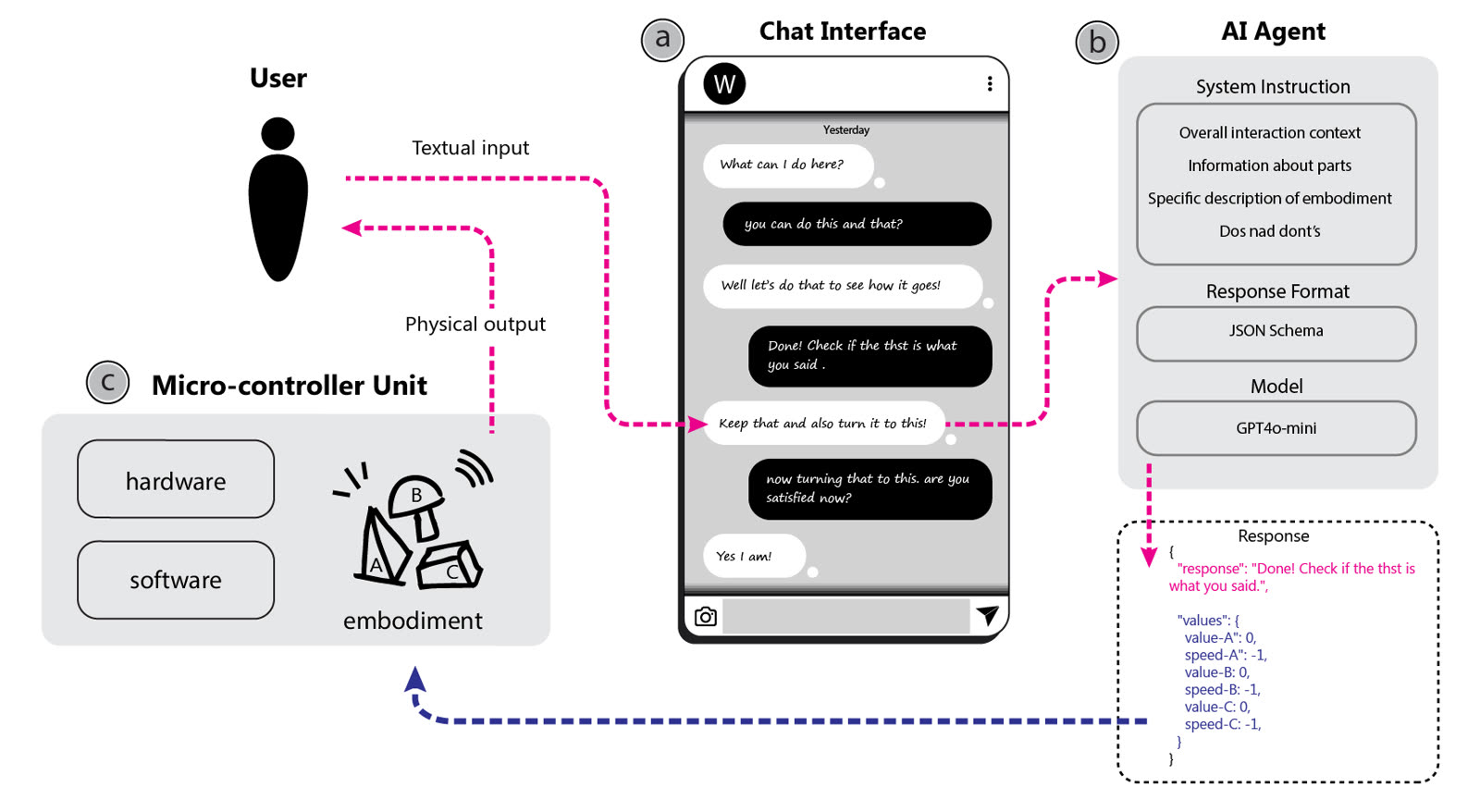
Every reply carries two outputs: language for you, and a JSON payload for the hardware. The payload travels over MQTT to a microcontroller, which executes it. That loop — prompt, structured response, actuation — is the whole framework.

System architecture: the user's chat interface feeds an AI agent carrying a system instruction and JSON schema; its response returns text to the chat and a JSON payload to the microcontroller, which drives the embodiment.
Prompt → structured response → actuation

What you need: an OpenAI-compatible API key, an MQTT broker (local or hosted), a microcontroller running CircuitPython or Arduino, and a Control Hub account. What you don't need: machine-learning experience, a fine-tuned model, or any code that parses natural language.

Built with Prompting Realities

Reference prototypes — Mahan Mehrvarz

Windmill Diorama

Mahan Mehrvarz

Three motorized windmills on a topographic model, driven from a Telegram chatbot. Conversational commands become motor speeds and directions, sent as JSON over MQTT. This is the reference implementation — the one documented in the GitHub repo.

the baseline pipeline
Pan-tilt robots — Kenwyn Hoefnagel, TU Delft IDE, 2025

Three prototypes on identical Pimoroni Pan-Tilt HAT hardware. Same two servos every time; everything that differs is in the description and the schema.

From the thesis Animistic interactions in conversation with LLM-powered robots — K. Hoefnagel, MSc Industrial Design Engineering, TU Delft, 2025 →

The Curious Observer

Kenwyn Hoefnagel

Adds a PiCamera with OpenCV object detection. The servos track what they see in a tight Python loop while the model narrates what it thinks the thing is doing.

vision input

The Reluctant Dancer

Kenwyn Hoefnagel

Extends the schema with dance_pattern arrays, making the model a choreographer: give it a genre or a mood and it composes the movement.

composed movement

The Conscious Traveller

Kenwyn Hoefnagel

Accepts photos over Telegram and uses a vision model to recognise itself in them, then composes a response from enumerated libraries of movement styles, patterns and combinations.

self-recognition

Tangible storytelling — Tianrui Pan, TU Delft IDE, 2025

Two narrative prototypes that push on what counts as output.

From the thesis Prototyping AI-enabled tangible storytelling — T. Pan, MSc Design for Interaction, TU Delft, 2025 →

The Story of 3 Cubes

The Story of 3 Cubes

Tianrui Pan

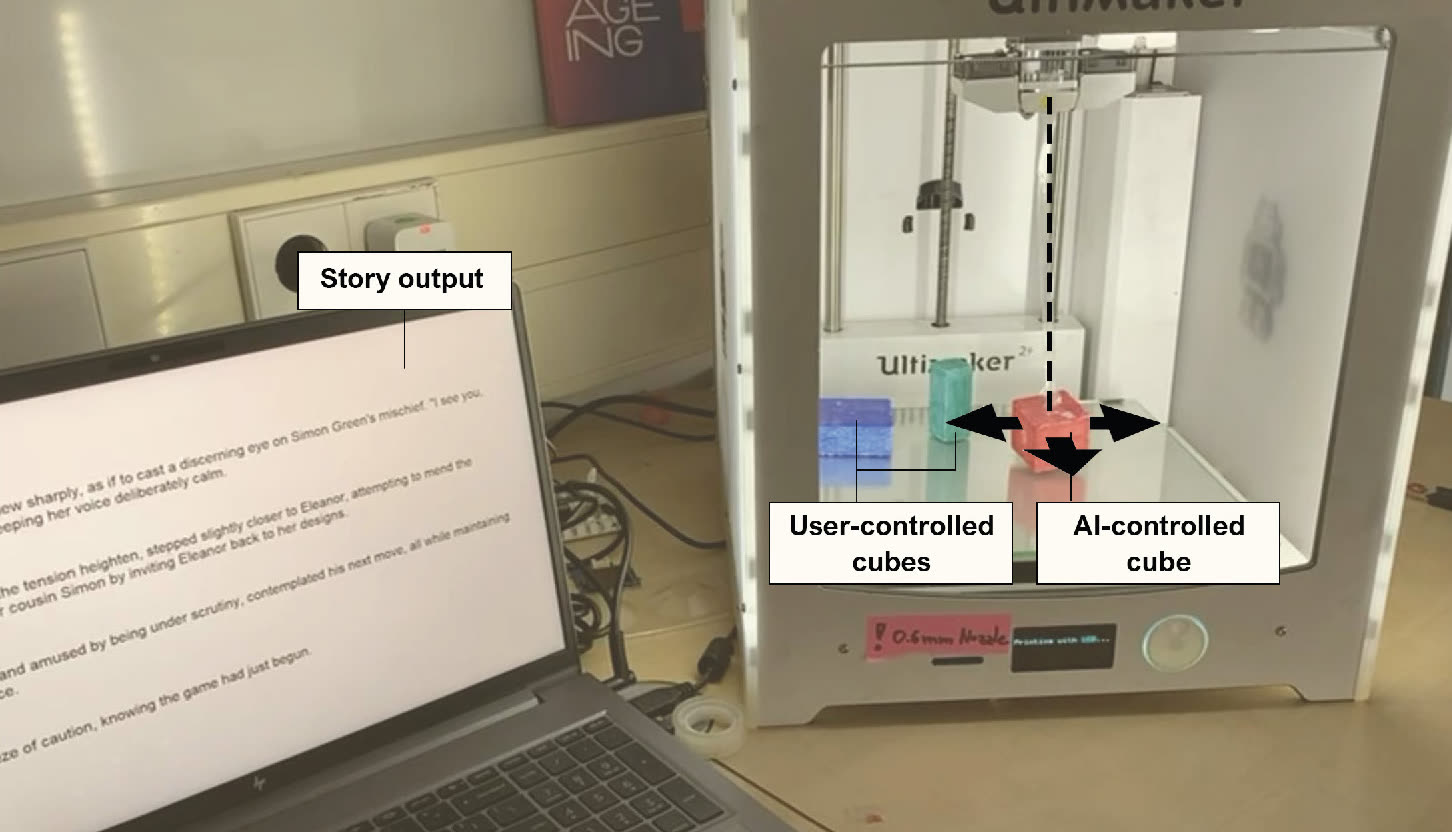
Three coloured cubes enact a noir narrative. You move two of them; the system moves the red one on a repurposed 3D-printer pulley, driven by what image recognition makes of the scene you just built.

system-moved props

Interactive Story Table

Tianrui Pan

The consolidated system: a wooden table with an embedded monitor, ArUco-marked game pieces, an overhead webcam and voice in/out. Two AI threads — a Story AI and a Supervisor AI — run in parallel, tracking four separate memory registers.

multi-agent

The Control Hub

The Control Hub is where your things live. Register an artifact, write and revise its description, choose a model, define the JSON schema it should emit, and watch the conversation and the resulting payloads side by side as it runs. Sign-up is open — bring your own API key and a board, and you can have something moving in an afternoon.

Create an account →

Tutorials

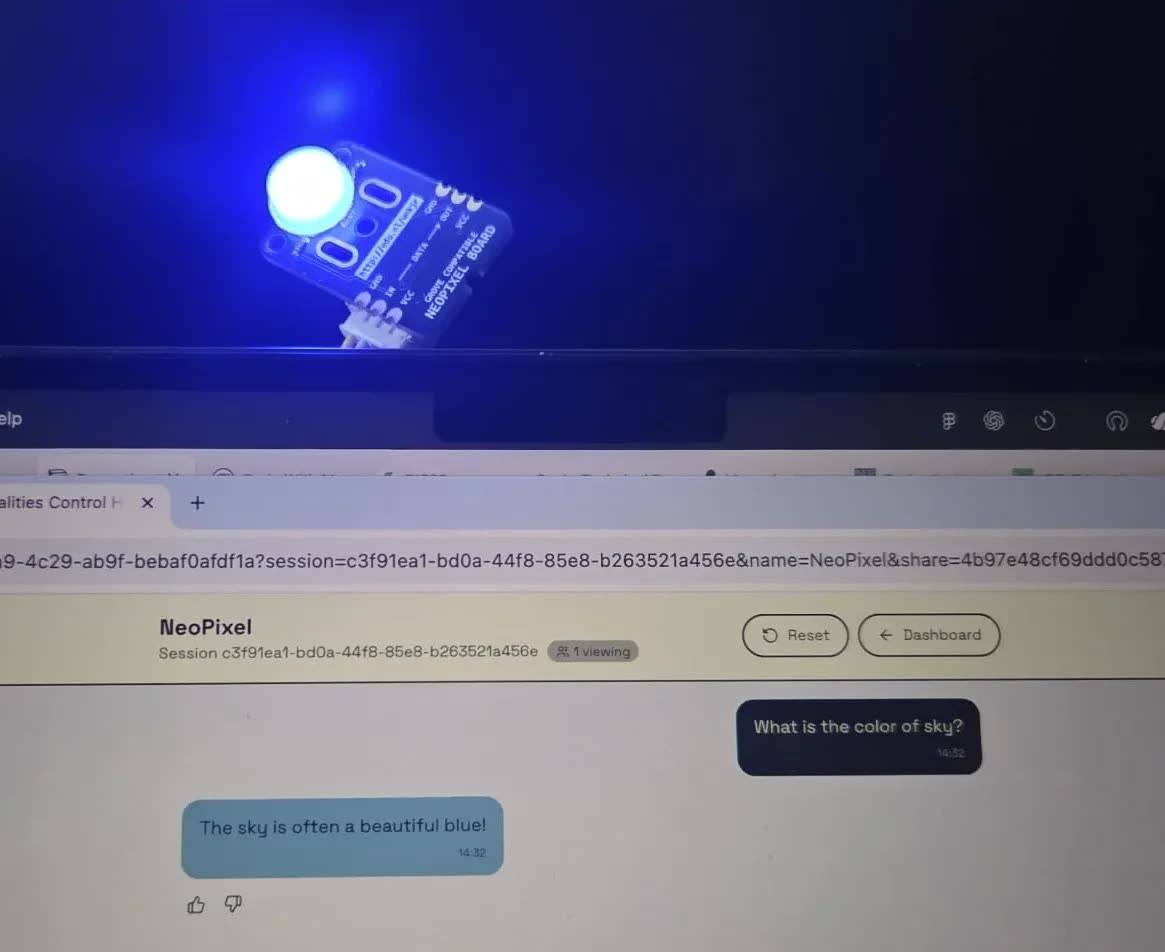
Start-to-finish guides for building an LLM thing — from a bare board to an object you can hold a conversation with. The first one takes you through a lamp: wire the LED, write its description and schema, and ask it for a colour.

Browse tutorials →

Workshops

Prompting Realities has been run as a hands-on workshop with design students and researchers: participants arrive with an everyday object and leave with a version of it they can talk to. If you'd like to run one with your group, get in touch.

Request a workshop →